
Search
The Pursuit of Happyness
-
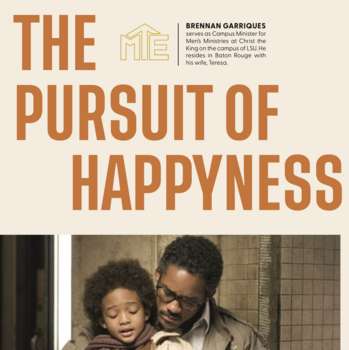 June 5, 2025The Pursuit of Happyness is a 2006 film about a man named Chris Gardner who struggles to find happiness in 1980’s America. It is a story of crucifixion—and of resurrection. Evocative of the journey from Lent into Easter, it is a reminder of the season of spiritual purification which anticipates the season of renewal and new life. While the movie does focus rather painfully on the purification portion of Chris’s journey, it is, in the end, an Easter story.
The audience is introduced to Chris Gardner (played by Will Smith) as a struggling salesman who can barely keep a roof over the heads of his wife and son. He has invested his life savings into cutting-edge portable bone density scanners, a new medical product which he has exclusive rights to sell in the San Francisco Bay area.
It turns out to be a poor business move. As we learn in a voiceover, “They gave a slightly denser picture than an x-ray… for twice the money.” Understandably, a medical professional in the opening minutes deems the device “unnecessary… and expensive.”
At this point, it is heartbreakingly clear to both Chris and his wife: this was not a good investment. She eventually leaves him and leaves their son, Christopher Jr. (played by Jaden Smith, who is also Will Smith’s son in real life), to his care. The remainder of the movie details the many sacrifices Chris makes to provide for his son. It is not easy to watch. Despite his intelligence, charisma, and strong work ethic, it feels like everything that could go wrong does. The chasm between Chris and the happiness he desires is simply too wide to overcome.
The plot is especially compelling because there are no overtly malicious characters, nor is there any clear antagonist for our protagonist to blame for his hardship. Rather, providence conducts the orchestra of chaotic tragedy and wonderful beauty that permeates Chris Gardner’s life. For him, it is an invitation to total dependence on the provision of God. For the audience, it is an invitation to look again at the string of events in the film. It turns out, even in the midst of all that goes wrong, there is much that goes right. Yes, we see the trials he endures, and it rightfully evokes a visceral reaction and empathy as we sojourn with our brother in this valley of tears. Do we also, though, see the saving hand of God as He acts over and over again in Chris’s life?
Here’s a striking thought, courtesy of my wife: at great cost to himself, Chris Gardner is determined to be a good father. It is fitting, then, that God the Father, who will never be outdone in generosity, would determine to be the same. Similar to Christianity, this movie is just as much about the love of a father for his son as it is about the pursuit of happiness. Indeed, it shows the two are intimately connected.
According to renowned spiritual author Thomas Dubay, “The New Testament assumes happiness is found not in things but in persons and especially in the Divine Persons” (Happy Are You Poor, 41). There is one scene in particular from The Pursuit of Happyness that I think captures what Dubay means. Interestingly, it is not the same moment that Chris deems as happiness in his voiceover at the end of the movie. Nonetheless, I think he would affirm what I say below.
Chris and Christopher have recently been forced to spend the nights at a local shelter after eviction from their motel. They are beginning to find a rhythm as Chris works during the day, scrambles to pick Christopher up from daycare, and then hustles over to the shelter to secure two of the limited spots. One day there is a church service where the Gospel choir sings passionately about dependence on the Lord as Chris holds his son close to his chest. He lets out a soft smile, consoled, it seems, by the proximity to his son and to the Divine. It is one of only two truly cathartic scenes in the movie.
Jesus says, “Unless a grain of wheat falls to the ground and dies, it remains just a grain of wheat; but if it falls to the ground and dies, it produces much fruit” (John 12:24). The fruit of death is meant to be superabundant happiness because, when we die, we are meant to come face-to-face with God. He is the source and summit of the happiness we seek. Similarly, Chris Gardner dies to himself over and over every day for the sake of Christopher, and the fruit is that he remains face-to-face with his son. Jesus Christ died for us so that the fruit might be that He always remains face-to-face with us. As the Psalmist proclaims:
Look to him that you may be radiant with joy,
and your faces may not blush with shame.
When the poor one called out, the Lord heard,
and from all his distress he saved him.
When the just cry out, the Lord hears them,
and from all their distress he rescues them.
The Lord is close to the brokenhearted;
and those who are crushed in spirit he saves (Psalm 34:6-7, 18-19).
If it were up to Chris, I do not think he would have written his story in the same way the Lord did. That said, it is in stories like his that the Lord finds Himself most at home. Our poverty and humility are irresistible to Him. He has shown us the path by which we are purified, and He has shown us the path by which we are renewed. They are one and the same: the way of the cross. The Lord has deemed that resurrection comes only after crucifixion, victory only after battle, that we find ourselves only through a sincere gift of ourselves. All of this is made evident in the Passion, Resurrection, and Ascension of Jesus Christ, “the leader and perfecter of faith” (Hebrews 12:2).
In The Pursuit of Happyness, Chris Gardner pours himself out as he seeks to provide for his son. He fights the good fight; he walks the way of the cross. So too does our Lord. He pours Himself out, and from His side springs forth eternal life. The pursuit of happiness is well worth the risk because, if we can remain with Christ on the way of the cross, then we will remain with Him forever in that most perfect happiness which will never end.
--
Brennan Garriques serves as Campus Minister for Men’s Ministries at Christ the King on the campus of LSU. He resides in Baton Rouge with his wife, Teresa.