
Rescuing the Righteous: Understanding Christ's Descent into Hell
-
 April 1, 2024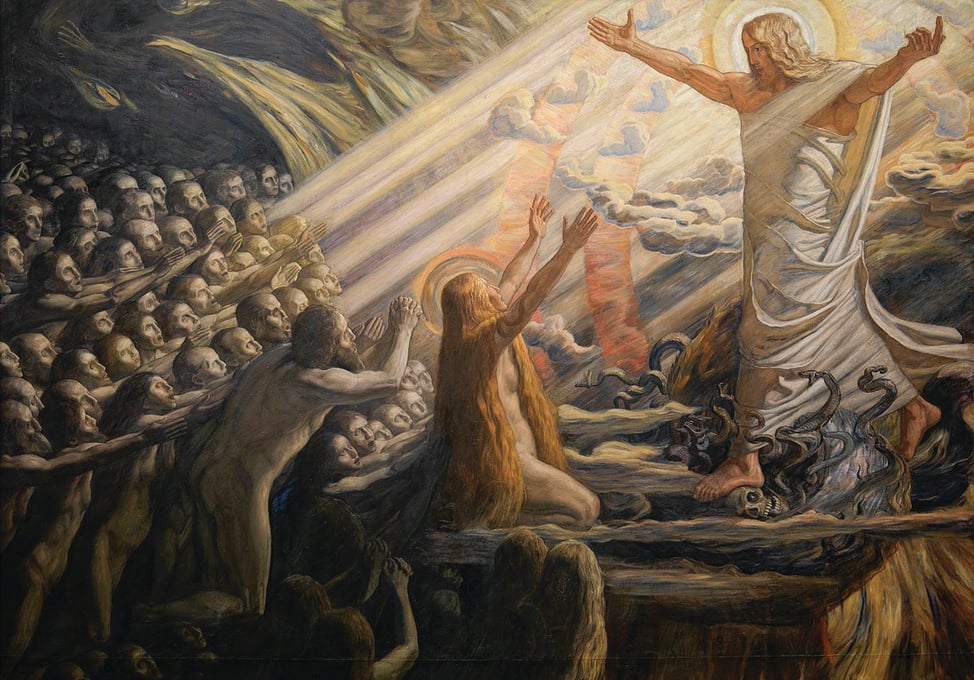
In the Apostles Creed, we profess that Christ “descended into Hell.” We ponder this mystery on Holy Saturday, but what does it mean that Christ “descended into Hell”? What is this “Hell?” Who was there? And why is it important to recall, even today, that we believe this? This article seeks to follow what is passed on to us in the Catechism of the Catholic Church (CCC) in paragraph numbers 631-637. This brief exploration will only scratch the surface of this mystery of our salvation, but it will give us a meditative, prayerful gaze for the Easter season.
How do we know that Christ descended into Hell? As Dr. Brant Pitre notes in his “Sunday Mass Readings Explained” series, we know it happened because it is in Scripture. For just one of the Scriptural examples that Pitre cites, we can look to 1 Peter 4:18, which says that Christ descended into the “prison” of the dead. Of course, this prison refers to Hell. But, is this the same Hell that we speak of today? Not exactly. The Catechism of the Catholic Church 633 notes that this prison had different sections in it. That is, in this one and the same “prison,” some souls were “damned,” while others were in the “bosom of Abraham,” as Jesus’ parable about the rich man and Lazarus illustrates in Luke 16:22-26. Obviously, the Hell we speak of today has no righteous souls in it, but why was this not the case from the beginning?
Put simply, before Christ’s death, we could not enter Heaven because it wasn’t a choice available to us, even for those who wanted to be with God. Why? Because we had been exiled from Paradise because of the Fall! This is the tragedy of Adam and Eve’s sin. But after Christ’s death, and through His descent into Hell and Ascension into Heaven, Christ gave humanity a choice we simply didn’t have before.
So, then, the righteous desired and hoped for Jesus, though they didn’t know Him. Their glory in life was their faith, hoping for someone they couldn’t yet see. They were like the wise virgins, watching during the long night for the desire of their soul, waiting for the Heavenly “bridegroom.” When they saw Him, they knew it was Him, heard His voice, and went to Him like sheep to their shepherd. Beautiful!
So, now, Hell is a place where only the damned are, because those who were righteous were liberated from their exile by Christ. Who were some of these righteous souls? Adam and Eve, to name just two, were among them. In fact, you might have seen a famous icon of Christ holding them by the hands and hoisting them up out of the crag-hole of Hell. It is hard to fully imagine the drama and beauty of this moment. The sinless Son of sinful Adam and Eve, saving them! But who else was there? Noah, Abraham, Isaac and Jacob, Moses, Rahab, David and Solomon, also would have been there. The Maccabean martyrs could also be named, as well as Lazarus, the imaginary figure who Jesus Himself spoke of. Certainly, imagining all these souls meeting Christ is worth our time, and will help us appreciate the tension of hope which was finally fulfilled on Holy Saturday.
But what more can we say about the relevance of this tenet of our faith today? We can think of at least two good reasons. The first reason is that it shows how God, in Jesus, perfects and redeems all salvation history. God did not just use the patriarchs and prophets as an on-ramp to His plan of salvation, and then discard them when He no longer needed them. Rather, God allowed them to see the fulfillment of what they prepared for when He went to them in their prison.
The second reason is the personal meditation it allows. It is one thing to understand the dogma and it is another to celebrate it. We are meant to live off the joy of these dogmas, not merely profess them. For that reason, I will zoom in on one person in particular, David, so that we can enjoy these dramatic encounters more deeply.
David, of course, had sadly fallen into the infidelity of lust. Given the charge of the kingdom, David ended up sacrificing one of his general’s lives in order to cover up the sin of his lust. He lived to repent of this with tears, because he knew it would affect not only him, but also his kingdom, forever. So we can imagine the fallen and contrite king David watching Christ from his prison of Hell, as Jesus lived as the true king that David never could find it in himself to be. David truly loved the kingdom, but was also weak, and his failures caused him to hurt those he loved. So David watched with joy as, one by one, Jesus filled up the holes that his own sins had caused in the fabric of the kingdom of God. And so, all the more, David rejoiced when this Lord, who while He lived reversed the effects of his own faults and failures as a king, then came to Hell, to redeem not only the fallen kingdom, but the fallen king himself! Jesus had come not to replace David, but to redeem him! Is there anything more beautiful?
To conclude, then, in the Apostles Creed, we profess that Jesus “descended into Hell.” Packed in those three words is a day filled with countless encounters as powerful as any of Jesus’ most dramatic encounters with sinners that are recorded in Scripture. Jesus had met all kinds of sinners before; but when He descended into Hell, He would meet the original sources of humanity’s broken relationship with God. Thus, He accomplished His saving mission, saving even those through whom He had begun it, and letting rebound on them, the very grace that they laid the foundation for, though imperfectly and often sinfully.