
Search
More Than A Ritual
-
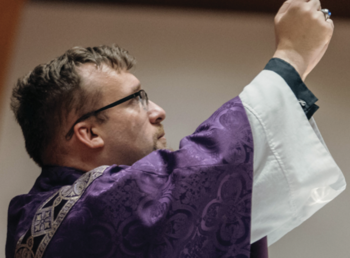 February 17, 2026A goal without a practical plan is going nowhere. Let’s investigate what you can do to go forward with your personal liturgical renewal. I am going to restrict myself to what will help you get more out of Sunday Mass because liturgy is expansive. There is a liturgy built around every sacrament, and the church has a daily liturgical prayer in the Divine Office. I am going to make a number of suggestions. Pick one thing to work on. When you have that down, then move on to the next. Bishop Simon Peter has given us two directions thus far: give fifteen minutes of family time to the readings for the upcoming Sunday, and pause between readings for reflection at Mass. Further, he plans to establish commissions to discuss ideas for liturgical renewal. Consider joining them if you have expertise or experience to add. While we await the commission process, here are some practical things you can do.
Before Mass
If you have already incorporated the readings, I encourage you to consider what you bring to Mass. I am not referring to pre-signing your contribution check, although that is also a good practice. Instead, you should have a specific intention. These can fall into two groups. First, you have a specific outcome you want from the Lord: to get that promotion, deliver a healthy baby, convert a friend, or ensure the safety of a traveler. Second, you have a more general prayer for a specific person: my child, parent, or spouse. This should be you sometimes.During Mass
Respond to the dialogue. Do not whisper “and with your spirit,” or say it in your mind. This is part of your prayer. Sing with the music, or at least be working towards greater participation with the ritual.During the Readings
Again, our Bishop has asked us to pause between readings for reflection. Recall and think about what you have heard. What did you like? What questions do you have? What was difficult? If you have not mastered this one during Mass, practice it before Mass by reflecting on the events of your day. The hardest piece for me is forcing attention so that I recall what I heard. I repeat the words as they are being said in my mind or at a whisper. Another way to make it more memorable is to visualize the readings where possible. Use your mind to rebuild the scene as it is being described. In the power of the imagination, the Holy Spirit speaks to you.During the Liturgy of the Eucharist
I have no concrete practice, but you should reflect on the reality that the Eucharist is at the same time Jesus’ sacrifice for our salvation and his true self. The Eucharist is the source and summit of our faith. This is the renewal and ratification of your baptismal covenant with God.After Mass
Offer a prayer of thanksgiving. Thank God for the gift of this Mass. You can practice this outside of Mass by thanking the people who help you. When a good thing happens to you, thank God for it.
There are a lot of suggestions here; pick one, get good at it, and then move on to another. If you do them all at once, you will be doing a bunch of new things all at once, get tired of it, and either give up or give minimal effort. Every habit is built on repetition, so keep at it even when it feels like you are not making headway. Finally, be on the lookout for the commission and more information.
--
Fr. Alex Gaudet is the Pastor of Christ the Redeemer Church in Thibodaux, a Staff Member of the Office of Worship for the Diocese of Houma-Thibodaux, and a member of the Board of Directors of the Catholic Foundation of South Louisiana.