
Search
A Conversation With Bishop Elect Simon Peter
-
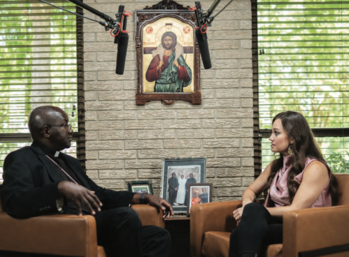 October 21, 2025A week before his ordination, Bishop-Elect Simon Peter Engurait joined Diocesan Communications Director, Bevi Fontenot, and Bayou Catholic editor, Joe O’Sullivan, for a wide-ranging conversation about his life, faith, and hopes for the future. We invite you to enjoy this behind-the-scenes glimpse of that exchange.
Q: Tell us about where you’re from in Uganda and what it was like growing up.
I was born and raised in Ngora, which is a small town in eastern Uganda. I’m one of fourteen children. My father was the headmaster at the school for the deaf. Looking back, we were poor but we weren’t even aware of it. My parents were stricter than most. I had a curfew, which felt unfair as a child, but now I realize it taught us discipline and gave us rules for life. It served myself and my siblings well in life and all of us were able to go through college (and more than half of us went through graduate school). In retrospect, I saw that some of the kids who didn’t have those rules didn’t make it very far in life.Q: Do you have a favorite childhood memory?
Oh yes—“Ngora’s Rock!” You can look it up on Google; it’s a big mountain of rock. As kids, we would climb up and slide down using plastic cut jerrycans. Sometimes, we used banana stalks, but those wore out so fast. It was rock-sledding. Our parents told us not to do it, but you know what it’s like, the adrenaline takes over. [laughs] One day, when I was about 11 or 12, there was an accident and a boy got knocked out. We were nervous and we knew we’d be in trouble. But he came home an hour later. The lesson we learned was to listen to your parents! [laughs]Q: How did you discern your calling to the priesthood?
As a child, we had priests visiting our house. They always got special treatment, and they seemed really important! I wanted to be like them. So, at a very early age, I wanted to be a priest. At fourteen, I entered seminary and stayed all the way through college seminary. That formation was very important for me. It introduced discipline and a regimented life of prayer and devotion. But I felt there would be more exciting things to do in life than be a priest. [smiles] So, I went to a public university and worked for the Ugandan government for eleven years.
I had a flourishing career, but something was missing. I kept coming back to my childhood dream. Eventually, I knew the Lord was calling me to the priesthood, and I decided to re-enter the seminary.Q: What do you love about the community in Houma-Thibodaux?
I first came to this country in the year 2000, but I would mostly visit the East Coast. I always felt out of place. You know when you go to a place and you just don’t connect? I remember vividly my first Sunday in this country. I decided to go to Mass at the Basilica of the National Shrine in Washington, DC. I wanted to greet everybody at the end of Mass but I was told not to do that! I wanted to shake hands, but people didn’t seem to want to. I was super friendly and tall, and no one seemed to want to talk to me. That was my experience. I came to DC and New York for business mostly and it was very sad—people smiled at me in the boardroom but ignored me on the metro. They had plastic smiles. That was my impression of America—a plastic life.
But when I came to Louisiana, it was a totally different world. I stayed with Bishop Jacobs and would go to events with him. One of our first events was with deacons. I had brought a book because I knew that no one would talk to me, and I would be bored. As soon as we got there, I couldn’t read that book! [laughs] Everyone was talking to me! I connected with so many. The next day, people came by the bishop’s house to drop off food. That showed me how great the people are here!
The way people live here also reminds me of home. Many families all live down the same street and they can point to each other’s houses! Where I come from, it was similar. All my relatives lived within two miles of each other. So, you get it? It’s the same feel. Then, there’s the food—there are a lot of similarities to the food back home. We use onions, tomatoes and bell peppers back home in Uganda as a base, and we make a lot of stews with gravy. It’s a little different but still the same! And even the terrain is similar. From the beginning, it felt like I belonged here. I felt home.Q: You’ve served under several of our bishops. What did you learn from them?
What I admire about Bishop Jacobs is his prayer life. It was amazing. I lived with him for a year and just watched him pray. When he would get back from the chancery every day, he would go into the chapel right away to pray. He would also go to adoration first thing in the morning. No matter what, he was there. I really admired his preaching, too, especially his altar calls. He was bold and he challenged people to give their lives to Jesus. He was so dynamic!
Bishop Fabre taught me about both gentleness and firmness. He had a consultative, collaborative approach to ministry and decision-making. He had deep discernment and vision for the diocese; he was a visionary leader!
Bishop Mario—the thing that I admired about him most was his joy! He had conviction, and if he wanted to do something, just get out of his way [laughs]. But he also made you feel like you were the only person in the room.Q: What kind of bishop do you hope to be?
I believe the Lord is calling me to be a pastor—to lead people to the love and saving presence of God by bringing my experience at St. Bridget to a broader church. I can apply what I learned there on a broad scale.
At St. Bridget, I invested a lot of time in preparing couples for marriage, because the marital covenant is the foundation to family life. Where you have strong families, you have strong communities. I want to see more intentional ministry to families across our diocese.
I also want to focus on the formation of young people, both in our schools and parishes. We have good tools already, but I want to see us use them more fully.
And I want to continue outreach to the poor and vulnerable, which the rite of ordination for bishops says explicitly. That call struck me: to preach and teach to all, especially strangers and outsiders.Q: How can we foster unity among all Christians?
One of the greatest scandals is the divisions in the Body of Christ. Jesus himself prayed that they may be one as we are. So, working towards Christian unity is very, very important. And it begins with recognizing the things that unite us. There are so many things that unite us and very few that divide us. So why don't we begin from there?
It's [important] to recognize where people are in their lives and acknowledge our common humanity. For us as Catholics, we have the dignity of every human person enshrined in our doctrines.
One of my desires has been to strengthen outreach in parish communities. At St. Bridget, we formed the St. Vincent de Paul Council. It was very active—one of the most active councils in the diocese. Probably 75% of the people that we helped were not Catholic. That's a powerful testament: we do it not because they are Catholic, but because we are Catholic. We recognize in them the dignity of the human person, as children of God, and hopefully through that, they'll come to know the Lord.
For example, we see “Joe” in the community and he’s 93 years old. He's a widow and he's living by himself. His ramp is broken, and he's struggling. As a parish community, we could help him fix his ramp, not because he's Catholic, but because he needs it. If we can have acts of service like that, that’s where true religion is. That's where true Christianity is. Those kind of practical interventions in the lives of people is what brings Christ to the community.Q: Do you have a favorite Saint?
I have many! But my favorite saint is Saint Ignatius of Loyola. He’s changed my life. He helped me to understand God.
As I was struggling to discern the call of God, I wanted God to speak to me like he spoke to Moses, like a burning bush, like he spoke directly to Saul. In the past, I looked for many weird signs trying to discern God’s will. But that’s just not how it works. Later, I learned about Ignatian spirituality. Through an introduction to the Jesuits, I discovered the beauty of St. Ignatius.
St. Ignatius, in my own words, teaches us that God built and wired us a certain way. And within us is a way that we can connect with God; that’s how he built us. By being attentive to what St. Ignatius calls “interior movements”—what happens inside us, like our feelings, our thoughts, and our desires, we can come to know how God wants us to live our lives.Q: Do you have a favorite Scripture?
The one that I've been drawn to lately is Exodus 14:14: “The Lord will fight for you; you have only to keep still.” This is helpful for me, especially because September 5 [the Installation and Ordination Mass] is going to change me, and the Spirit has been warning me that trials are waiting for me.
The scene of Exodus 14 is about the Exodus. The Israelites are crossing the Red Sea. God has led them from slavery. God has performed miracles for them, and He's led them all the way to that point where Pharoah is hunting them. They think they’re dead. The people cried to Moses and said to Moses that he should have left them in Egypt. But Moses says, “you need only be still.”
You need only to be still and trust. When we have those moments, we forget about the God who could change a stick into a snake…God who could make darkness that you could cut thick…God who could turn water into blood. Why don't you trust that he's going to create a way? Why don't you trust God? I think that's where our weakness and our failure comes in. We don't trust God enough.Closing Thoughts
Bishop-Elect Simon Peter’s reflections show us that he is a man of faith, humor, and deep care for his people. His journey has shaped him into the pastor he is today, with his heart and care for all. May we follow his example of leading with love, building unity, and saying “yes” to Jesus.