
Search
170 Years of Catholic Education
-
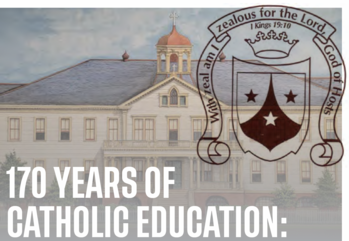 January 6, 2026In 1845, Pere Menard watched as children from Catholic families began attending Protestant schools. It inspired him to act by building Catholic schools for Catholic families. After years of building churches, rectories, and helping in the Yellow Fever epidemic, Pere Menard turned his attention to schools. He wrote to Sister Theodora, Superior to the Sister of Providence of Terre Haute, Indiana, asking them to come and help form a Catholic school so that “young girls could receive a Christian education” (Pere Menard Journal, 1845 entry). Awhile later, after the price of the school had been agreed upon and purchased, Pere Menard suddenly received a letter that Sister Theodora was dying and that her death would “delay the convent by 18 months” and worse, her replacement, “didn’t want to send the sisters to Louisiana” (Pere Menard, 1846 entry). Pere Menard kept looking for a new order to replace those sisters, contacting the Ursulines in New Orleans who also turned him down. He then approached Mother Therese, Superior of the Sisters of Mount Carmel. Mother Therese explained that the sisters were poor and “would need a long time to pay for the property,” but Menard persisted. Borrowing the money himself, he began to construct Mt. Carmel convent and school.
After the girls’ education was settled, a fortuitous opportunity occurred with Mr. Shifferstein deeding Thibodaux College to Father Menard. The private boys’ school which had been founded in 1859 was given to Menard on July 18, 1861. He re-opened the school for a new school year on September 2, 1861, which he called St. Aloysius Academy. On May 2, 1872, Menard purchased property and re-located Thibodaux College and began putting out listings for boarder students almost immediately.The Sisters Come to Thibodaux
The Congregation of the Sisters of Our Lady of Mount Carmel were known to the Lafourche area, having arrived in Plattenville in 1833 under the advice of Rev. Charles Boutelou. With Menard having already built the school, the Sisters of Mount Carmel came to Thibodaux at Pere Menard’s request. On October 1, 1855, the Mount Carmel Academy opened with 45 pupils, including both day students and boarders (Pere Menard, 1855 entry).
During various Yellow Fever epidemics, the sisters would “put aside their role of teachers in order to alleviate the sufferings of their neighbors” (Centennial, 20). Their foundress, who believed her “primary function” was to “care for the sick” and “bury those who had none left to mourn them,” left a great example for the sisters stationed in Louisiana (Centennial, 20). During the Civil War, the Sisters “gave shelter to wounded and fatigued soldiers, regardless of uniform color” and shared “already-scarce supplies of food with those who had less or none” (Centennial, 20). When the Civil War concluded, the Sisters quietly resumed their teaching. The school grew and flourished before becoming a parochial school that began educating boys in primary grades beginning in 1910, before the school was eventually given back to the Sisters in 1926. The school grew and grew under the Sisters, becoming particularly large between the 1890s and 1950s, with Mount Carmel Academy being badly damaged in Hurricane Betsy in 1965. The damage to the buildings was heartbreaking for the Sisters, but they were invited to join the Sacred Heart Brothers at the new Thibodaux Central Catholic High School.Arriving Twice: The Sacred Heart Brothers
In July of 1891, the Brothers of the Sacred Heart accepted the offer of management for Thibodaux College. Many of the brothers lived and worked in Thibodaux for three years before they left in 1894 after their buildings were not repaired. In 1911, Rev. Alexander Barbier became St. Joseph’s new pastor and had a new building built for Thibodaux College in 1912. He asked the Brothers of Sacred Heart to staff the new school and they agreed, returning to Thibodaux after 18 years.
Four brothers taught 100 boys for the 1912-1913 school year in grades fourth through twelfth. Father Barbier and the Brothers worked well together. It was noted that he appreciated the brothers and their “smooth running of Thibodaux College” (Plus Fifty, 299). The school grew by leaps and bounds with enrollment soaring and more brothers coming to help teach. The school soon boasted nine brothers and 330 students for the 1954-1955 school year. Starting in 1962-1963, with the opening of St. Joseph’s elementary school, the fourth grade was dropped with an additional grade being ceded to St. Joseph each year. This practice continued until the 8th grade, making Thibodaux College a high school, now with grades eighth through twelfth. By 1964, the interior of the school and brothers’ residence were both in poor shape. But with Archbishop Cody’s new school which had broken ground in the summer of 1964, change was in the wind for the brothers and the local Catholic families.Working Together to form Catholic Education in Thibodaux
Before Hurricane Betsy, Archbishop Cody had decided that a newer and larger Catholic high school was needed and set about arranging the building of Thibodaux Central Catholic, a high school that would include both boys and girls on the same campus.
After Hurricane Betsy hit on September 5, 1965, it severely damaged both Thibodaux College and Mt. Carmel Academy, forcing the Archbishop to move up his timetable up by a year for opening this new school—with students beginning at the new school earlier than planned. TCCHS (as it became known) was divided into a boys’ and girls’ division with each having its’ own principal in charge of their educational program. The diocesan priest, appointed by the Archbishop, would be the chief administrator who would mainly handle the finances.
In March of 1966, Archbishop Cody re-named the school Edward Douglas White Catholic High School in memory of the Honorable Edward Douglass White, from Thibodaux, who served as a Supreme Court Justice from 1910-1921. E.D. White Catholic High School has continued developing and growing to this day, recognized still as an excellent school offering top-knotch College preparatory Catholic education in the Thibodaux area.The End of an Era: Withdrawal from Thibodaux
Both the Sisters of Our Lady of Mount Carmel and the Brothers of the Sacred Heart left Thibodaux and E.D. White due to low numbers in their orders, thus leaving them unable to continue teaching and serving at E.D. White and in the local community. The presence of the Sisters and Brothers is still felt in the pride and faith they instilled in the local Catholic families, especially the generations of students from that tutelage. The missions of both religious orders were to foster Catholic education in local youth, but more importantly, to lead by serving the local people. That spirit of serving others still rings true today in the people of Thibodaux and E.D. White Catholic High School, which has become a lasting tribute to all the religious who served there—along with the generations of Catholic families who have, for the last 170 years, supported quality Catholic education.Sources:
The Annals of the Church of St. Joseph (aka Pere Menard Journal), Parish of Lafourche, State of Louisiana 1842-1892
The Catholic Church in Louisiana by Roger Baudier
The Brothers of the Sacred Heart in North America
Echoes of Carmel. Published by the Sisters of Mount Carmel-New Orleans
Mount Carmel Academy Centennial 1855-1955 Thibodaux, Louisiana
Plus Fifty: Another Half-Century of Service 1947-1997 by the Brothers of the Sacred Heart